
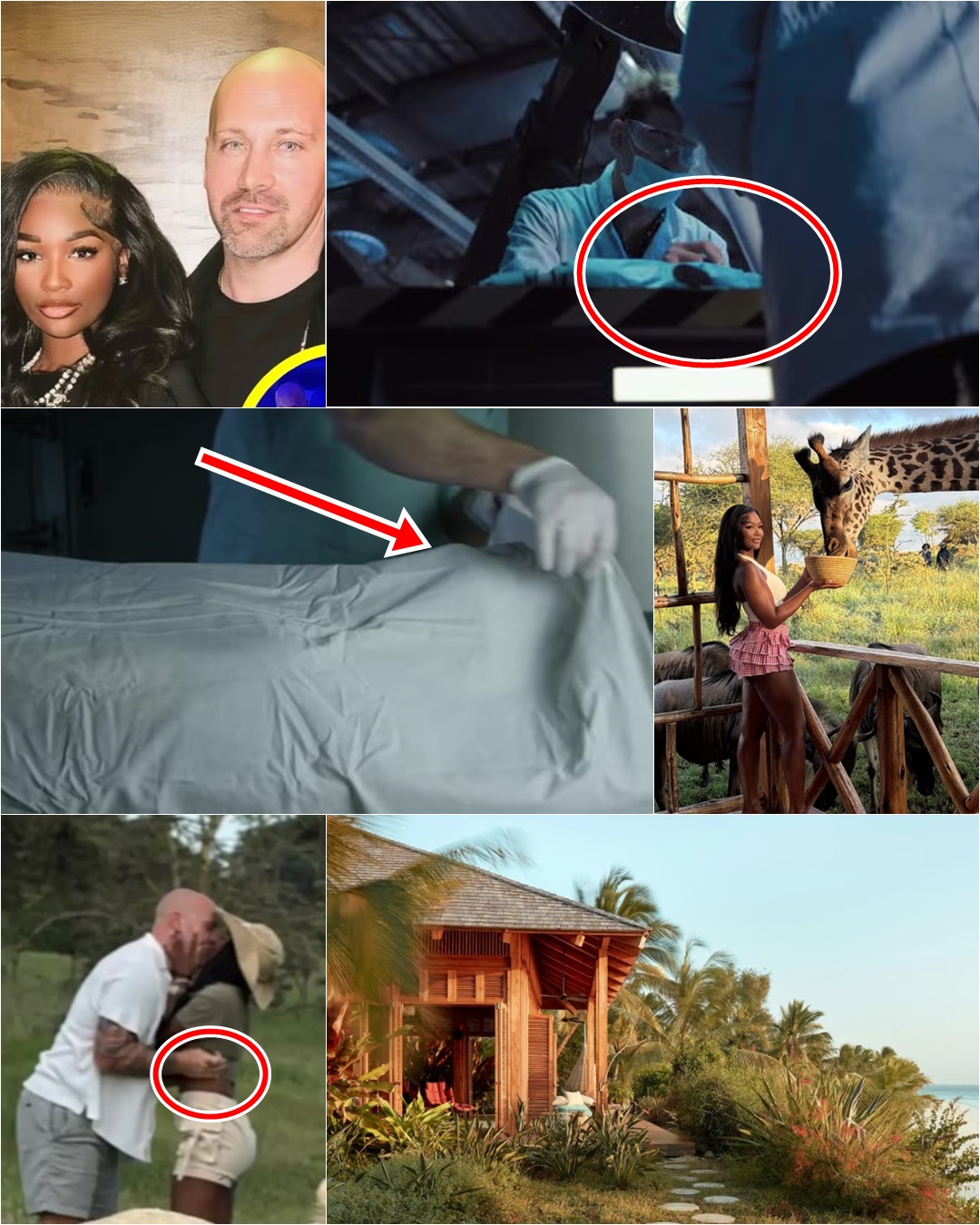
The autopsy findings in the death of Ashlee Jenae have begun to outline a clearer — yet still deeply unresolved — picture of her final moments.
According to preliminary forensic reports, the initial cause of death has been described as asphyxiation, a condition resulting from a lack of oxygen. This finding is broadly consistent with the account that she was discovered in a hanging position inside her hotel room. On the surface, the medical conclusion appears to align with a scenario of self-inflicted hanging.
But in forensic investigations, it is rarely the headline conclusion that tells the full story.
Instead, attention has increasingly turned to a more precise and telling detail: the ligature mark found on her neck.
Forensic examiners are known to treat such marks as critical evidence. The shape, depth, and direction of a ligature mark can provide insight not only into how death occurred, but under what circumstances. In this case, while full details have not been publicly released, sources indicate that a clearly defined mark was present — consistent with compression of the neck.
What remains unknown is far more important than what has been confirmed.
Investigators are believed to be analyzing three key aspects of the mark:
First, its pattern. In cases of hanging, the material used — whether fabric, belt, or cord — can leave distinctive impressions. A smooth surface may produce a uniform band, while textured materials can leave identifiable patterns. If such a pattern exists, it could help determine exactly what object was involved.
Second, the angle. A ligature mark that slopes upward toward a fixed point is typically associated with hanging. By contrast, a horizontal or evenly distributed mark may raise questions about other mechanisms. Without official disclosure, it remains unclear where on this spectrum Ashlee’s case falls.
Third, the depth and distribution of pressure. A deeper or uneven mark could indicate variations in force or movement, while a more uniform impression might suggest a static position. These subtle differences are often central to distinguishing between different scenarios.
Alongside these physical findings, another detail has emerged: reports indicate that DNA recovered from the ligature material is consistent with the victim herself. At first glance, this may support the theory that she handled the object used. However, forensic experts caution that such a result is not definitive on its own. In a confined environment like a hotel room, it would not be unusual for personal items to carry only the victim’s DNA.
This brings the focus back to timing.
The sequence of events leading up to her death remains only partially established. There is a window of several hours between the last confirmed contact and the reported discovery of her body. More notably, there are claims of a delay — approximately 10 to 11 hours — before her family was informed.
From an investigative standpoint, this gap introduces uncertainty.
If the ligature mark reflects a straightforward hanging, the timeline should align with a relatively clear sequence of events. But if inconsistencies emerge — either in the mark itself or in the recorded movements leading up to the discovery — those hours take on greater significance.
Several plausible scenarios remain under consideration.
One possibility is that the physical evidence will ultimately align with a self-inflicted act, with the ligature mark and DNA findings supporting that conclusion. Another is that subtle inconsistencies — in the mark’s characteristics or the timeline — may suggest the involvement of additional factors not yet fully understood.
At this stage, no single explanation has been confirmed.
What is clear is that the ligature mark, often seen as a routine forensic detail, has become a central piece of evidence. Its exact characteristics — still undisclosed — may hold the key to understanding whether Ashlee Jenae’s death was a tragic act of despair, or something far more complex.
Until those details are made public, the case remains suspended between possibilities — defined not only by what is known, but by what has yet to be revealed.