
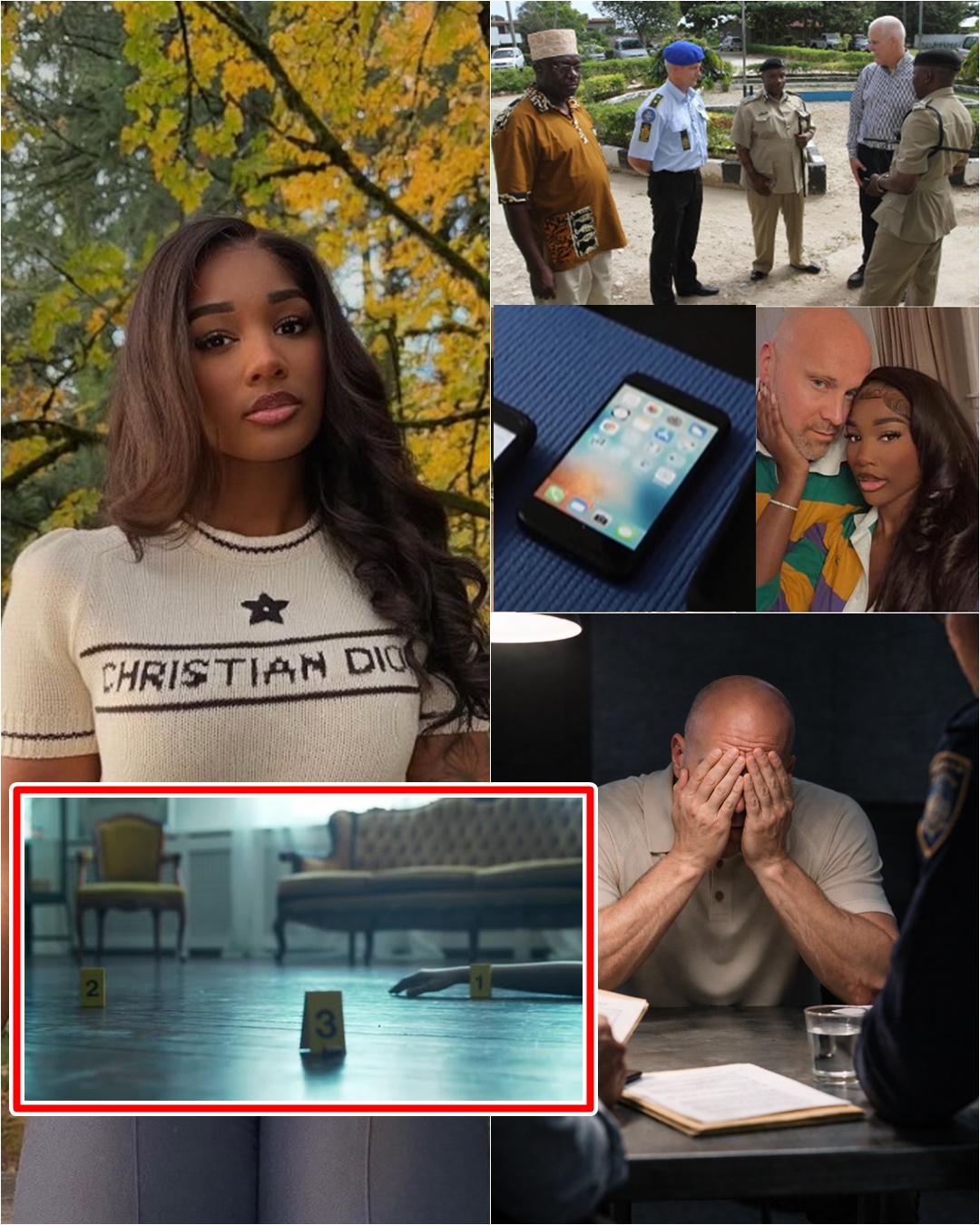
The death of Ashlee Jenae has drawn increasing scrutiny, not only for the circumstances surrounding her final hours, but for the fragmented and evolving account provided by her fiancé, Joe McCann. What exists publicly is not a formal transcript or complete statement, but rather a patchwork of reported remarks, indirect communications, and summaries filtered through media and family accounts. Within that fragmentation lies a pattern that investigators—and observers—find difficult to ignore.
According to available reports, McCann was among the last people to see Jenae alive. The two had reportedly been involved in a heated argument prior to the incident, significant enough that hotel staff intervened and separated them into different rooms. This detail alone does not imply wrongdoing, but it establishes a volatile emotional context immediately preceding her death—one that naturally draws attention when reconstructing timelines.
McCann’s initial communication with Jenae’s family has become one of the most closely examined elements of the case. Rather than offering a clear description, he reportedly stated that she had “done something to herself.” The phrasing is notably vague. It avoids direct acknowledgment of cause or method, creating ambiguity at a moment when clarity would typically be expected. Whether this was the result of shock, confusion, or deliberate restraint remains unclear, but the effect is the same: it leaves space for interpretation.
More striking, however, is the reported delay in communication. Accounts suggest that approximately eleven hours passed before Jenae’s family was informed of her condition. In cases involving sudden death—particularly in foreign environments—timeliness of notification is often seen as a reflection of both urgency and transparency. The gap raises questions not because it proves intent, but because it introduces uncertainty. During that window, critical actions may have taken place: interactions with authorities, internal questioning, or simply the processing of events. Without a clear record, the delay becomes a void into which speculation inevitably flows.
Further complicating the narrative are discrepancies in how the discovery of Jenae was described. Some reports indicate that McCann found her alone in the room. Others suggest he returned with hotel security before the discovery was made. These are not minor differences. In investigative terms, the distinction between discovering a body alone versus in the presence of witnesses can significantly affect the interpretation of events, timelines, and credibility. It is unclear whether these inconsistencies originate from McCann’s own statements or from variations in how media outlets have reported them. Either way, the result is a lack of a single, stable account.
Another focal point is McCann’s reported explanation of the scene itself. Claims that Jenae was found in a state consistent with self-harm introduce a narrative direction, but without publicly available forensic confirmation, such descriptions remain unverified assertions rather than established facts. In investigative contexts, early characterizations of a scene—especially by involved parties—are often treated cautiously. They may reflect genuine observation, but they may also be incomplete or influenced by perception under stress.
Behavior immediately following the discovery also warrants attention. While details remain limited, standard investigative frameworks would examine whether emergency services were contacted promptly, what actions were taken in the moments after the discovery, and how consistently those actions align with later statements. These are not accusations; they are routine lines of inquiry in any unexplained death.
It is important to emphasize that Joe McCann has not been publicly charged in connection with the death. By current accounts, he has been questioned as part of an ongoing investigation. In such circumstances, inconsistencies or ambiguities in statements are not uncommon. Stress, trauma, and the disorienting nature of sudden events can distort memory and communication. At the same time, investigators are trained to examine precisely those distortions, distinguishing between natural human error and patterns that may suggest deeper issues.
The case, as it stands, is defined as much by what is unknown as by what is known. There is no complete transcript, no unified statement, no definitive timeline publicly confirmed in full. Instead, there is a series of partial accounts—each adding a layer, but none forming a complete picture.
In that absence of clarity, the scrutiny of McCann’s reported statements continues. Not as proof of guilt, nor as evidence of innocence, but as one component in a broader effort to understand what happened in the final hours of Ashlee Jenae. Until more concrete findings emerge, the narrative remains suspended—tense, unresolved, and defined by questions that have yet to find stable answers.